I love animals and I love random facts. Even better, I love random animal facts. Recently I saw a bird called a honey buzzard on television. The feathered animal caught my attention for a short spell so I figured I would share the knowledge I gathered.
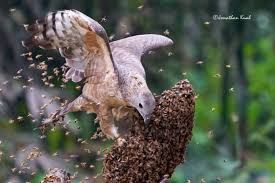
European Honey Buzzard
European honey buzzards are within the family of Accipitridae. Instead of buzzards, they are more closely related to the hawks and eagles. They grow 20-24 inches tall and have a wing span of 53-59.7 inches. The bird is a summer migrant to small areas in western Palearctic from most of Europe to as far East as southwestern-Siberia. They have a wide range of habitats from exotic plantations to woodlands. These birds typically migrate to tropical Africa for the European winters.
European honey buzzards primarily live on the larvae and nests of wasps and bees. Although, they will munch on small prey such as smaller birds, rodents and frogs. They build nest tall in the trees but tend to be spotted on the ground near nests. All of these birds are sexually dimorphic, meaning there have separate and unique colors, patterns and physical characteristics differences between male and female.
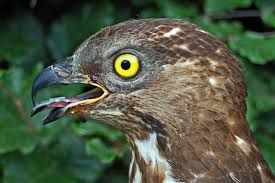
They have beaks with elongated tips designed to hold insects securely. Their feet are long and wide, specially designed to grasp honey comb. Scale like feathers cover the head and neck along with a chemical deterrent on the feathers to protect against stings. Heavy scaly armor cover their feet and legs further adding to their resilience against the bees venom. They have narrow nostrils to prevent their noses from becoming clogged with wax or soil from the prey’s nest. These birds are one of the few animals that can and will eat the killer hornet. A unique and well equipped bird in the animal kingdom.
To follow the same theme of honey and bees let’s look at tiny insect with a huge belly.

Honey Pot Ants
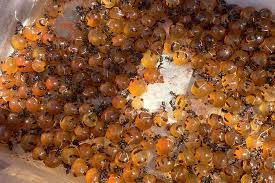
Honey pot ants eat both live and dead insects along with nectar from various plants. Certain workers, called repletes, develop huge extended bellies by consuming massive amounts of food. After this engorgement they become translucent and immobile, anchoring themself to the roof of their underground nest.
They essentially become living larders for the whole community. During times of drought or low food supply the other ants extract the nourishment from them by trophallaxis. First, a fellow ant strokes the antenna of the honey pot ant who regenerates the virtual nutrients. These distinct ants make up about 49% of the colony, always protecting the survival of the next generation.
The honey pot ants have a vast habitat ranging from arid & semi-arid regions of the United States, Mexico, Australia and Africa.
Indigenous Australians considered these a very special treat and have been known to dig over 9 feet in search of the delicacy. The native people also use the sticky liquid to treat sore throats, skin infections and inflammation. What a fascinating and marvelous little creature.
Thank you for reading my animal fun facts. I plan to post more periodically as the whim strikes me. I enjoy doing short articles like these about lesser known animals. As always have a great day and God bless.
Discover more from Heather Congrove
Subscribe to get the latest posts sent to your email.

I also loved the h🍯ney pot insect🐜
LikeLiked by 1 person
Yes, fascinating creatures, Heather! Thank you!
LikeLiked by 1 person
You are welcome. I am glad you enjoyed it.
LikeLiked by 1 person