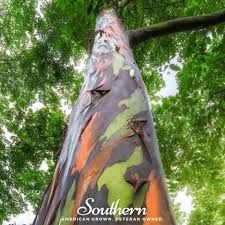
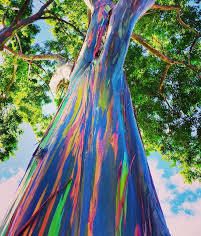
This marvelous tree can be found in the rainforests of the Philippines, Indonesia, and Papua New Guinea. The Rainbow Eucalyptus can grow as high as 250 feet with a diameter of up to six feet. It displays wonderful colors as the bark peels away in strips to reveal a canvas of green, red, orange, gray, and purplish brown hues. The shedding process reveals new colors and patterns, uniquely striking each tree. This color change and its towering height and large circumstance make it a true natural wonder.
The ecological role of the rainbow eucalyptus is multifaceted. Its rapid growth and large size make it vital for maintaining the structural integrity of the rainforest.
It offers habitat and nourishment to a myriad of species, from the microorganisms that feed on its decaying leaves to birds that nest in its lofty branches. Importantly, its roots help stabilize the soil, preventing erosion and maintaining watershed health.
https://www.oneearth.org/species-of-the-week-rainbow-eucalyptus/


The traveller’s tree gets its name from its breathtaking (and almost ridiculous) fan of leaves, which is reputed to orientate itself so consistently that it can be used as a compass. The fan of leaves tends to grow roughly on an east-west line, which some believe can serve as a crude compass for travelers. An outgrown relative of the Bird of Paradise flower, the traveller’s tree has large, bright turquoise blue seeds that are covered by a fuzzy aril that is edible.
The plant’s name comes from the fact that the cupped bases of its leaves can hold rainwater, which travelers have historically used as a source of drinking water.
https://www.wanderlustmagazine.com/inspiration/unique-trees-around-the-world/


The sandbox tree is a large tree in the spurge family and native through most of tropical America. This tree is among the largest trees of tropical America and is interesting for its pumpkin-shaped seed capsules that explode with a loud report, scattering the seeds. Sandbox trees have poisonous leaves, bark, and seeds and the explosions of their capsules, which have enough force to injure persons or livestock, can be deadly.
The sandbox tree is nearly 100 feet tall with a girth of more than 3.3 feet. The trunk is studded with short conical prickles. The long-stalked dark-green leaves cover a round-crowned high-branching tree. The globose seed capsules are 3 inches in diameter and were used in colonial British West Indies as sandboxes for blotting ink. Some indigenous groups mix the poisonous latex with sand to stupefy fish.
https://www.britannica.com/plant/sandbox-tree


The jabuticaba tree, also known as the Brazilian grape tree, is a unique tropical plant native to southeastern Brazil. It is famous for its fruit growing directly on the trunk and branches, resembling purple warts when in season. Jabuticaba trees thrive in humid climates and prefer moist, rich, slightly acidic soil. These trees are slow-growing, taking 8-10 years to produce their first fruits.
The sweet, juicy berries are edible and can be eaten raw or used to make jams, jellies, juices, and even wine. They are packed with nutrients, including vitamins, minerals, and antioxidants. The fruit provides a vital food source for many animals, including birds, monkeys, and bats, and the tree’s dense foliage provides habitat and shelter for wildlife.
In Brazil, the jabuticaba tree is an important cultural symbol, often featured in traditional folklore and local dishes and drinks.
The name “jabuticaba” is derived from the Tupi word “jabuti” (tortoise) and “caba” (place), meaning “place of the tortoise”.
https://specialtyproduce.com/produce/Jabuticaba_12325.php#:~:text=Jabuticaba%20is%20thought%20to%20have,to%20produce%20their%20first%20fruits.

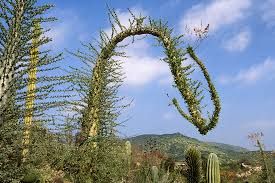
The boojum tree and little known trees native to the Baja California and Sonora regions of Mexico. It thrives in arid desert environments. It stands out among the other desert plants with its unique silhouette. It’s shaped like an upside-down carrot with skinny branches reaching skyward.
One of the most interesting adaptations of boojum is how it stores water. The plant’s trunk gets bigger at the base, forming a bulb shape that holds water during periods of drought. Boojum can survive in the desert without rain for a long time, which is important for its survival.
Boojums are dormant during the warmer months. During the winter, boojums grow very slowly, adding only about 2 inches to their height each year. The Boojum tree may look a bit bare with its skinny branches and small leaves, but when it flowers it is a sight to behold. As they break dormancy in late summer to early fall, clusters of tubular flowers pop up from the tips of its branches. The blooms paint the desert landscape with subtle colors of white and pink.
https://btarboretum.org/the-boojum-tree/#:~:text=One%20of%20the%20most%20interesting,is%20important%20for%20its%20survival.
I hope you enjoyed reading. Have a great day and God bless.
Discover more from HC Content
Subscribe to get the latest posts sent to your email.

Excellent and interesting information about these unique trees – a profound testimony to God’s marvelous and magnificent work! Thanks for sharing.
LikeLiked by 1 person
I am glad you liked it. Thank you for your comment and God bless
LikeLike
Very interesting.
LikeLiked by 2 people
Thank you
LikeLike