Dirt, Water and Life

Mud- the rudimentary inventiom of adding water to dirt to create a sticky, dynamic medium. A substance not only for building childhood memories but a cornerstone of civilization that has shaped landscapes, provided shelter and continues to be an unsung hero of the global carbon cycle.
The Geological and Chemical Anatomy of Mud

Dirt + Water = Mud, simple right? Not exactly.
Geologically, mud is defined as a mixture of silt, clay, and/or loam combined with water. The composition is key, as the particle sizes dictate its behavior and uses:
Clay: The part that is responsible for mud’s sticky, cohesive, and plastic nature. High-clay mud has low permeability, causing it to retain water and bake hard when dried.
Silt: Silt gives mud a smooth, velvety texture and makes it slippery when wet. Silty mud is often highly fertile.
Sand: Sand imparts grittiness, reduces stickiness, and improves drainage.
Loam: A balanced mixture of sand, silt, and clay, often considered the most ideal type of soil for agriculture.
The Origin Story: From Rock to Sediment

The journey of mud begins with the weathering of crystalline igneous rocks (like granite). Over millions of years, the forces of wind, water, ice, and chemical processes break down large rocks into ever-finer particles. These particles are then transported by rivers, glaciers, and wind, eventually settling in environments where water is abundant.
When these ancient mud deposits are compressed and hardened over geological time, they form mudrocks, such as shale and mudstone—some of the most common sedimentary rocks on Earth. Essentially, if you want to read the planet’s history, look at its mud.
Mud as a Foundation of Life: Ecological Roles

Mudflats are far from a deserted wasteland. Muddy environments are among the most productive and biologically important habitats globally. Each one plays a crucial role in nutrient cycling and carbon sequestration.
Intertidal mudflats (or tidal flats) are highly fertile coastal wetlands, often found in sheltered bays and estuaries. They are ecological powerhouses:
Nutrient Cycling: Muddy sediments are rich in particulate organic carbon (POC). The anaerobic conditions below the surface are perfect for microbes and bacteria that break down organic matter, regenerating essential nutrients like nitrogen and phosphorus back into the water column.
Biodiversity: Mud is home to specialized marine life, collectively known as infauna. This includes burrowing animals like bivalves (clams and mussels), worms, and crustaceans, which thrive in the soft substrate. These organisms are, in turn, a primary food source for migratory shorebirds and fish.
Carbon Sink: The muddy seafloor is a massive natural sink for carbon dioxide. Organic carbon from decaying marine life (like phytoplankton) sinks and gets buried in the mud, where the low-oxygen conditions prevent full decomposition. This carbon is effectively locked away for millennia, making muddy coastlines a key ally in climate regulation.
Mud and Humanity: From Ancient Shelter to Modern Spa
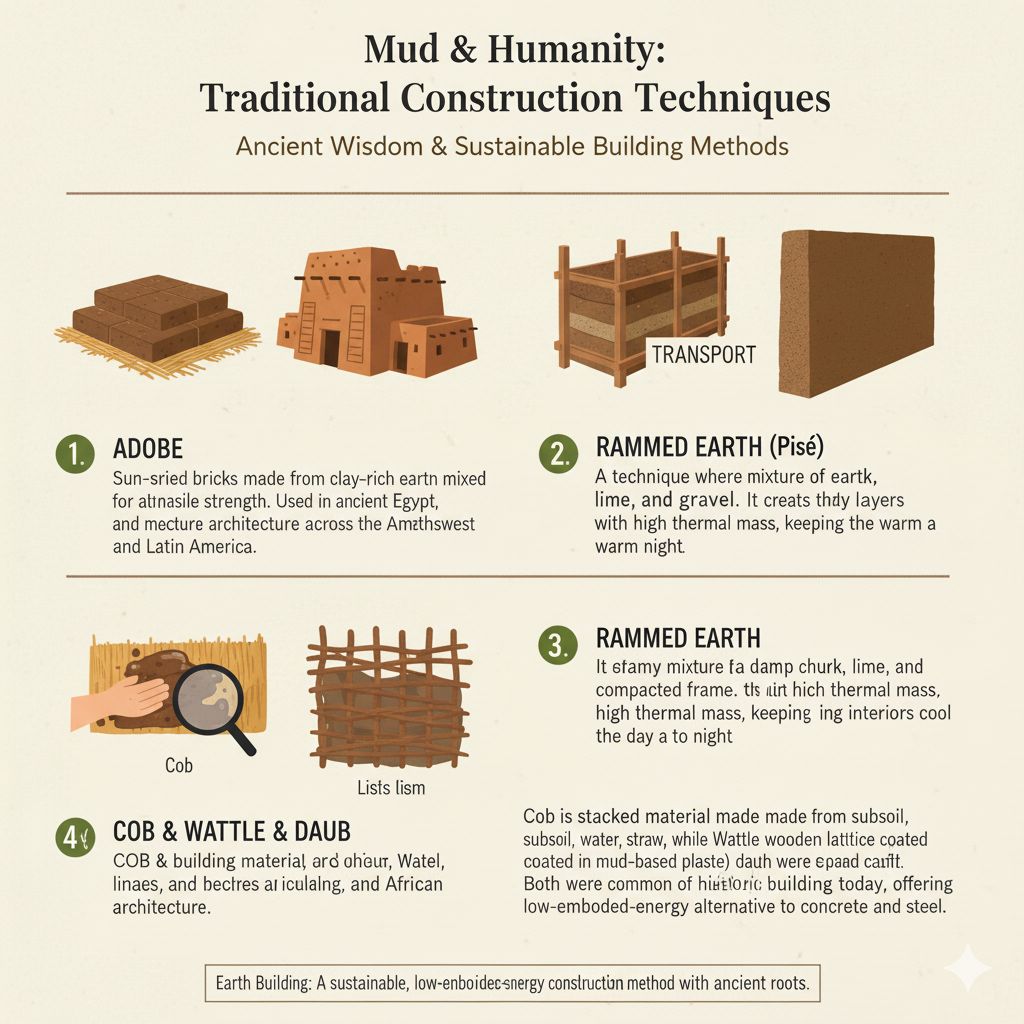
Interestingly, the prevalence of mud can be traced as far back as man himself. Humans have utilized the unique properties of mud for nearly every aspect of civilization, forming it from a nuisance into a resource. This cost effective, readily available material is not only a great insulator but has excellent thermal properties as well. Today, mud comes in many forms and varieties and is used in numerous different ways. Below are a few construction techniques that outline the basic makeups and procedures.
Adobe: Sun-dried bricks made from clay-rich earth, often mixed with straw for added tensile strength. Used in ancient Egypt, Mesopotamia, and modern architecture across the American Southwest and Latin America.
Rammed Earth (Pisé): A technique where a damp mixture of earth, chalk, lime, and gravel is compacted in layers within a temporary frame. It creates thick, extremely durable walls with high thermal mass, keeping interiors cool during the day and warm at night.
Cob and Wattle & Daub: Cob is a stacked material made from subsoil, water, and straw, while Wattle & Daub uses a woven wooden lattice (wattle) coated in a mud-based plaster (daub). Both were common in historic European and African architecture.
The resurgence of earth building today highlights its sustainability, offering a low-embodied-energy alternative to concrete and steel.
Therapeutic and Industrial Uses

Beyond construction, mud has found purpose in health, industry and sports.
Balneotherapy (Mud Baths): Mud rich in volcanic ash, minerals, and hot spring water has been used for thousands of years in therapeutic mud baths. These treatments are believed to relieve arthritis, improve circulation, and soothe skin conditions due to the minerals and heat retention properties of the clay.
Drilling Mud: In the oil and gas industry, “drilling mud” (or drilling fluid) is a complex mixture of clay, water, and chemicals pumped into a wellbore. Its functions are critical: to cool the drill bit, carry rock cuttings out of the hole, and maintain pressure to prevent blowouts.
Baseball Mud: The practice of rubbing down new baseballs began officially in 1938 when Philadelphia Athletics coach Russell Aubrey “Lena” Blackburne discovered a special kind of mud along a tributary of the Delaware River in New Jersey. Before this, teams used harsh, inconsistent substances like shoe polish or infield dirt, which often damaged the leather of the glossy, slippery new baseballs. Blackburne’s mud was unique because its blend of fine silt, clay, and sand would dull the factory sheen and provide a crucial, consistent grip for pitchers without scratching or discoloring the hide. This Lena Blackburne Baseball Rubbing Mud quickly became, and remains, the only legal substance permitted by Major League Baseball (MLB) to prepare game balls. The mud is collected from a secret location and is still used today before every professional baseball game to ensure every pitch is thrown with a ball that has the ideal, non-slick texture.
Conclusion:
A deeper appreciation from the deepest ocean trenches to the high-plains adobe villages, mud is a ubiquitous and potent force. It is the raw material of the geological past, a bustling, life-sustaining ecosystem in the present, and a sustainable building block for the future.
The next time you encounter a patch of mud, take a moment to look past the mess. You are standing before a substance that is highly complex, ecologically critical, and utterly essential to the history and future of life on Earth.
Sources:
https://citychangers.org/mud-fact-file/
https://fpdcc.com/did-you-know-its-international-mud-day/
https://kids.kiddle.co/Mud
https://www.mymajors.com/career/mud-worker/
https://baseballrubbingmud.com/
Discover more from Heather Congrove
Subscribe to get the latest posts sent to your email.

Fascinating look at a not so lowly subject. I still like to play in it.
LikeLiked by 1 person
Me too!
LikeLiked by 1 person
Very informative! As someone who gardens, I appreciate it’s abilities to grow the chemical free food we eat and the flowers that bring us enjoyment.
LikeLiked by 1 person